15 milliliters versus 10. The American tablespoon far exceeds the one that sits in our French drawers. A difference that, slipped into a translated recipe without adaptation, opens the door to daunting discrepancies, and sometimes to unexpected failures. Transitioning from an imperial system to a metric system is never just a simple game of equivalences; it takes more than a quick calculation to get it right.
Some ingredients require heightened vigilance, such as yeast or gelatin: here, accuracy is not a detail. The texture, the final appearance of the dish, everything can tip over for a simple measurement discrepancy. The differences between weight and volume impose reliable benchmarks, or risk destabilizing the entire preparation.
Why culinary conversions are essential for successful recipes
In the hustle and bustle of the kitchen, precision makes all the difference. An ingredient measured too generously, a liquid underestimated, and the balance of a recipe wavers. Conversions do not belong to the realm of theory: they ensure a faithful, flavorful, reproducible result. Measurement in cooking shapes every recipe, especially when the units differ from one country to another or from one ingredient to another.
The question of units of measurement in cooking quickly becomes complex as soon as it involves transitioning from volume to weight, or alternating between liters, centiliters, and grams. While the liter remains the reference for liquids, each ingredient has its own density: 10 cl of oil does not have the same mass as 10 cl of milk. Converting centiliters to grams thus becomes an essential step, depending on the nature of what one is preparing. The method detailed in “Easy and Quick Method for Converting cl to grams – Les Recettes Légères de Chrissy” helps avoid common mistakes, especially when faced with recipes from elsewhere.
Mastering these measurement conversions allows for the same texture and taste in every attempt. Experienced cooks know this all too well: everything hinges on the accuracy of the doses, the careful reading of a measurement, the choice of reliable tools. It is better to rely on a unit conversion guide, whether juggling with a tablespoon, a cup, or an electronic scale. Conversion errors rarely go unnoticed: a cake that collapses, a sauce that is too thick, a dish that no longer resembles anything.
Adapting a recipe to the tools at hand, choosing the right unit, adjusting according to the specifics of each food: this is the path to consistent, tasty, successful results. Conversion in cooking is a pragmatic approach, far from overly easy approximations.
Practical charts and tips for easily converting volumes, weights, and temperatures in cooking
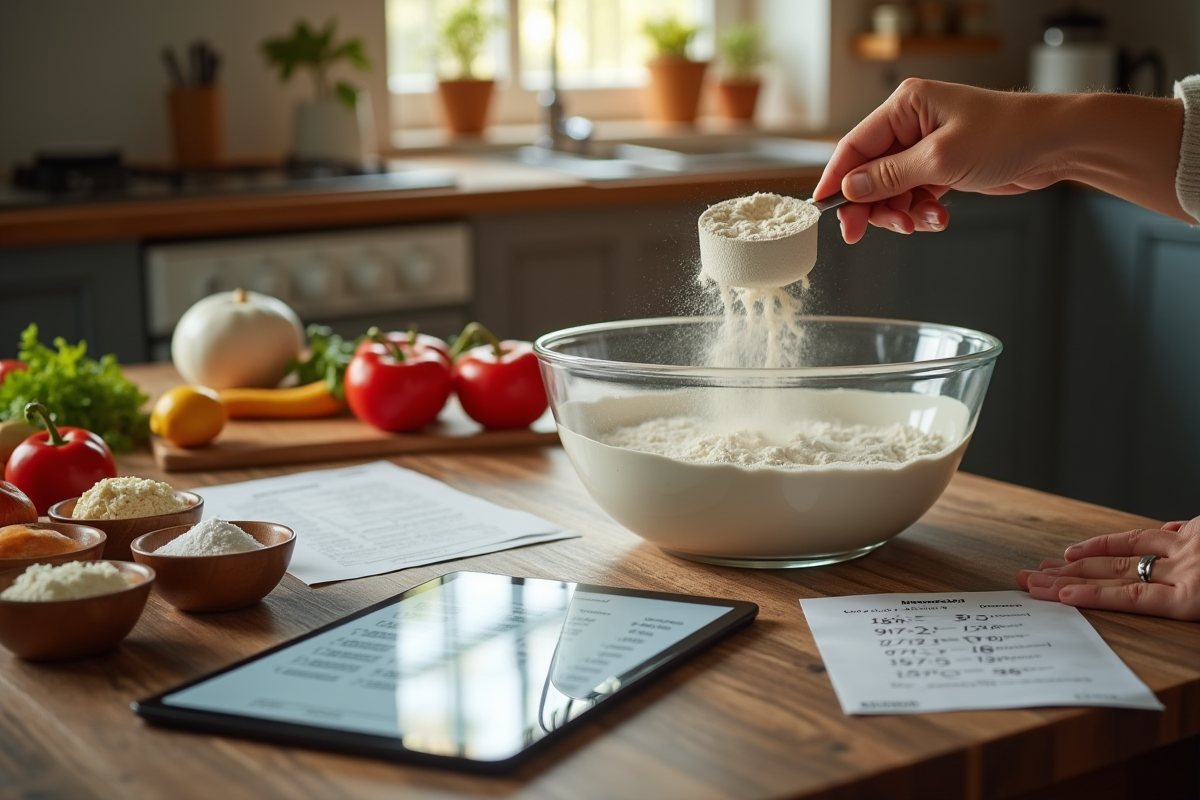
The conversion of volumes and weights is part of the daily routine in any kitchen. To leave nothing to chance, dosing accurately becomes a reflex: the tablespoon translates into milliliters, the centiliter transformed into grams, the temperature shifting from Celsius to Fahrenheit. To navigate this, a few practical charts serve as a compass, silent yet decisive. Here are some benchmarks to keep on hand:
- 1 tablespoon: 15 ml
- 1 teaspoon: 5 ml
- 1 centiliter: 10 ml
- 1 standard cup: 250 ml
Transforming a centiliter into milliliters seems obvious: 1 cl indeed equals 10 ml. However, this rigor avoids unpleasant surprises, especially when conversions accumulate or when adapting a foreign recipe. On the scale, 10 cl of water weighs 100 grams, but the same volume of oil never shows the same mass. The conversion of units of measurement thus requires taking into account the specifics of each ingredient every time.
For temperatures, the method remains simple: multiply the value in degrees Celsius by 9, divide by 5, and add 32 to get the corresponding Fahrenheit value. The reverse operation involves subtracting 32, then multiplying by 5 and dividing the result by 9.
Some tips make a difference: prefer reliable measuring spoons, precise graduated cups, or a trustworthy electronic scale. These instruments provide the reliability sought, whether for converting milliliters to centiliters or adjusting a cooking temperature to the exact degree. This attention to detail fosters consistency and success in dishes, whether preparing a meticulous dessert or a family recipe.