
Expired flour is an organic waste rich in starch, making it compostable but also particularly tricky in a domestic bin. If not managed properly, it causes exactly the nuisances that urban composters fear: sticky clumps, anaerobic fermentation, and an invasion of gnats. Here, we detail the mechanisms at play and the methods that actually work.
Carbon/Nitrogen Ratio of Flour and Compost Balance
Wheat flour behaves like a rapidly decomposing nitrogen input. Its C/N ratio is low compared to classic brown materials (dead leaves, cardboard, wood chips). When added in quantity to a composter without compensation, it drops the overall ratio well below the optimal microbial operating zone.
This imbalance has a direct consequence: the flour ferments instead of composting. In an environment that is too wet or too compact, anaerobic bacteria take over, producing organic acids and releasing sulfurous odors. The process can escalate in just a few days during warm weather.
We recommend always pairing flour with at least an equivalent volume of dry structuring material. Wood chips, branch chippings, shredded brown cardboard, or dead leaves are suitable. Sawdust works, but be careful not to compact it: it tends to form impermeable layers as well. To know precisely where to throw expired flour in the compost, mixing it with these brown materials remains the basic rule.
Flour in Compost: The Technique of Fractional Sprinkling
Pouring an entire bag of flour into a garden composter is the first mistake. Flour hydrated by rain or ambient humidity forms a compact paste that even vigorous mixing cannot dislodge. This mass becomes a focal point for gnats and maggots.
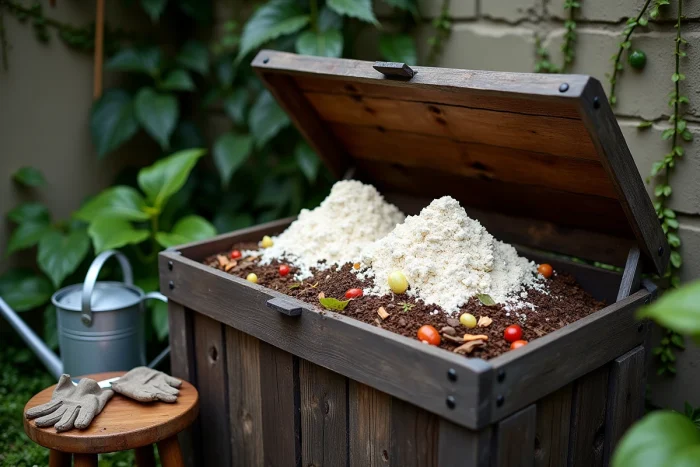
Distributing the input over several weeks radically changes the outcome. A few handfuls per mixing, immediately mixed with the existing green and brown waste, decompose without forming a crust. Specifically, we never exceed the equivalent of a large glass per addition in a standard domestic composter.
The mixing is not enough: the flour must also be buried under the top layer. Left on the surface, it attracts rodents and birds, and dries into a film that prevents aeration of the pile. Covering with dry brown material after each addition forms a natural filter against pests and odors.
Aeration and Turning After Addition
A composter receiving flour must be mixed more often than usual. The decomposing starch quickly consumes the available oxygen. Without regular turning, the environment can shift to anaerobic conditions in just a few days.
With a rotating composter, a complete turn after each addition is sufficient. For an open bin or a heap, mixing with a fork throughout the depth remains the most reliable method. Mixing should occur within hours of the addition, not the next day.
Flour Infested with Moths: Compostable Under Conditions
Flour overrun by food moths or weevils raises a legitimate question: do these insects pose a problem for compost? The short answer is no. Moth larvae are themselves organic matter that normally decomposes in an active composter.
The real risk lies elsewhere. Heavily infested flour often contains silk filaments and cocoons that form a hydrophobic network in the pile. This mesh slows water penetration and hinders microbial colonization. It is necessary to break this structure by crumbling the flour manually before incorporating it, or by roughly sifting it to disperse the clumps.
Additional precaution: do not compost this flour in a bin located immediately next to the pantry. Adult moths can infest food stocks within several meters. It is better to use a composter far from the house or a heap at the back of the garden.
Expired Flour in Micro-Doses in the Vegetable Garden: An Alternative to the Composter
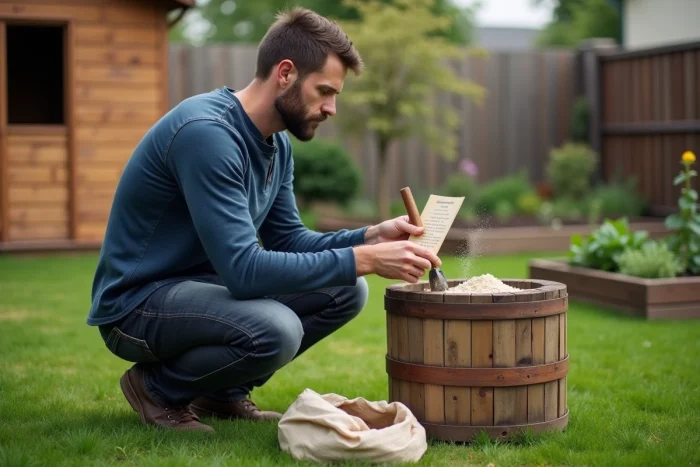
Sending everything to compost is not always the best option, especially with a small urban composter where the available volume is limited. Gardening practitioners use expired flour directly in the soil, as a surface nitrogen amendment mixed into the soil before planting.
The method is simple:
- Sprinkle a thin layer of flour on the vegetable garden soil, between rows or at the bottom of the planting hole.
- Immediately rake to incorporate the flour into the top few centimeters of soil, without leaving a visible layer on the surface.
- Lightly water to initiate decomposition and prevent the wind from dispersing the powder.
This technique works in micro-doses. When applied in excess, flour creates an impermeable crust on the soil surface that blocks rainwater infiltration and suffocates soil life. A handful per linear meter is a reasonable guideline.
Common Mistakes That Ruin Compost with Flour
Some mistakes consistently arise in feedback from composters dealing with large quantities of expired flour:
- Adding flour without brown material, which turns the compost into an acidic, foul-smelling mush in just a few days.
- Moistening the flour before adding it to the compost, thinking it will speed up decomposition. The result is a paste that clogs the entire bin and prevents aeration.
- Storing flour next to the composter while waiting to incorporate it, attracting rodents and pests even before composting.
- Putting significant amounts of flour into a worm composter. Worms poorly tolerate massive flour inputs, which quickly acidify the environment and can cause worms to escape the bin.
Expired flour remains a perfectly recyclable bio-waste, provided a simple principle is followed: never in bulk, always in mix, always buried. A well-mixed and balanced composter with dry materials digests flour without difficulty in a few weeks. The fractionation of inputs and regular aeration make all the difference between healthy compost and a pest problem.