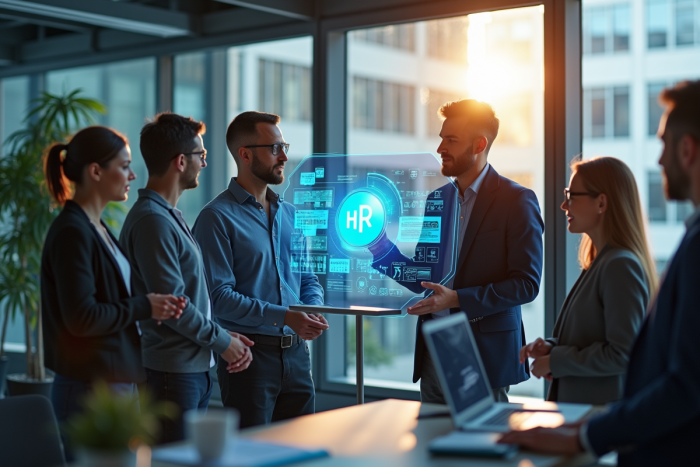
An algorithm, millions of profiles, and suddenly, human skill emerges from the shadows of spreadsheets. Automated skills recognition now goes beyond simple administrative management to establish itself as a strategic lever in talent retention. Artificial intelligence platforms evaluate and anticipate the evolution of jobs, disrupting the traditional hierarchy of skills.
Digital solutions are rethinking the dialogue between managers and employees, while predictive analysis is making its way into hiring and internal mobility decisions. The boundary between technological innovation and human support is shrinking, redefining expectations on both sides of the employment contract.
Overview of HR Trends: Between Accelerated Digitalization and New Employee Expectations
In the world of human resources, routine is no longer welcome. As the HR department broadens its scope, people management takes on a strategic, visionary approach and becomes more grounded in the field. Digitalization has reshuffled the cards: streamlined procedures, simplified processes, and increased flexibility at every stage. Remote work pushes the walls of the office, collaborative tools reveal the richness of collective intelligence, and administrative processes are refreshed through automation. The traditional job framework fades in favor of a thirst for recognition, usefulness, and freedom in daily organization.
New priorities are emerging: diversity, inclusion, and equality are now at the center of HR policy. The emphasis on soft skills, empathy, relational intelligence, and agility reshapes the image of the ideal candidate. Recruiters are now tracking these human strengths with renewed attention, and digital platforms are infiltrating all layers of the organization, facilitating direct and daily exchanges.
Concretely, several axes now structure the life of the company:
- Regular updates on quality of work life initiatives to strengthen engagement and prevent burnout risks
- Deployment of virtual workspaces and collaborative platforms that break down barriers and bring teams closer together, regardless of their location
- Adoption of interactive digital tools that renew social dialogue and nurture mutual trust
The perspective detailed by A&TA corroborates this dynamic: the shift from paper support to data management signifies not just a gain in efficiency but profoundly transforms work relationships. Companies and employees are now partners, reinventing together the scope and strategic weight of the HR service.

How Innovations Are Transforming the Employer-Employee Relationship on a Daily Basis
On a daily basis, the impact of these innovations is reflected in usage: information systems facilitate payroll management, automate absence requests, and free up time for what matters. In recruitment, artificial intelligence does not merely filter CVs: it detects soft skills, highlights discreet potentials, and gives a new dimension to talent selection. HR practitioners see their mission evolve, prioritizing quality human contact.
The onboarding experience is no longer fixed in a standard path. Newcomers discover the company through online escape games, immersive workshops, and quickly gain autonomy and peace of mind. For training, it’s all about adaptive learning: programs adjust to real needs, correct gaps, and stimulate individual and shared progress. This revitalizes the circulation of knowledge.
Support regarding employee benefits is changing dimension. Pre-packaged formulas give way to personalized offerings, with arrangements designed for mental health or feedback mechanisms that contribute to evolving internal solutions. This visible and felt attention strengthens long-term loyalty.
To provide a concrete overview of these developments, several practices are now established in the daily field:
- Rigorous and personalized management of the candidate experience from the very first interaction, to build trust and strengthen the employer brand
- Ongoing diagnosis of training needs, allowing anticipation of job changes and enhancing adaptability
- Facilitated exchanges through ergonomic platforms, accelerating processes, reducing delays, and uniting the entire team around the same objective
As transformations unfold, the organization of work and managerial practices detach from old constraints. The vertical model gives way to a more open partnership, driven by dialogue and the search for shared meaning. HR innovation is not a digital dictate: it creates the conditions for a space where everyone takes ownership of their choices, broadens their horizons, and transforms collective momentum into a true engine. What comes next? Perhaps the surprise of a trajectory drawn by many hands, and the certainty that work is no longer as it once was.