
Your suitcase is packed, your passport is ready, but nothing distinguishes your black luggage from the hundreds of others on the conveyor belt. A home-printed label on thick paper solves this problem in just a few minutes. The minimalist PDF format can be cut, folded, and attached without special equipment.
Paper Weight and Lamination: The True Lifespan of a Homemade Label
Most free PDF templates do not specify a crucial point: the choice of paper determines the label’s durability. A standard office sheet disintegrates at the first rain on the tarmac or when it comes into contact with a damp carpet.
Opt for paper with a sufficiently dense weight, such as business card or Bristol board. This type of material can be used in most home printers without special settings.
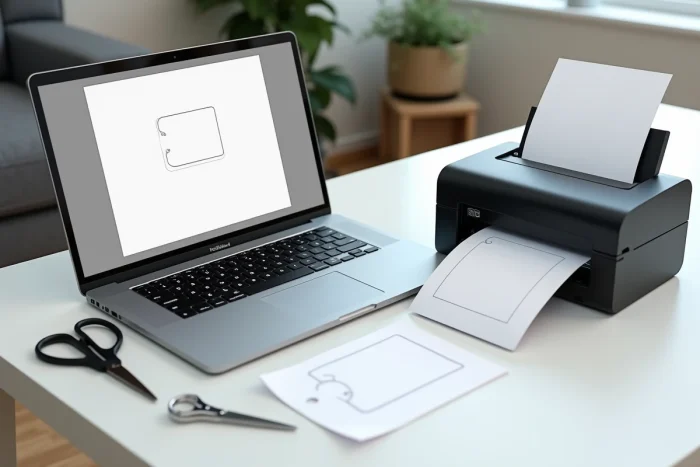
You can also download your printable luggage label from Voyage aux Pays des Merveilles, then cover it with a simple roll of wide transparent adhesive tape. This trick replaces a laminator for a waterproof result without a machine.
If you travel often, a cold lamination pouch (self-adhesive, no heat) offers a stiffer finish. It can be found at stationery stores for a few euros and protects the ink from moisture, abrasion, and UV rays.
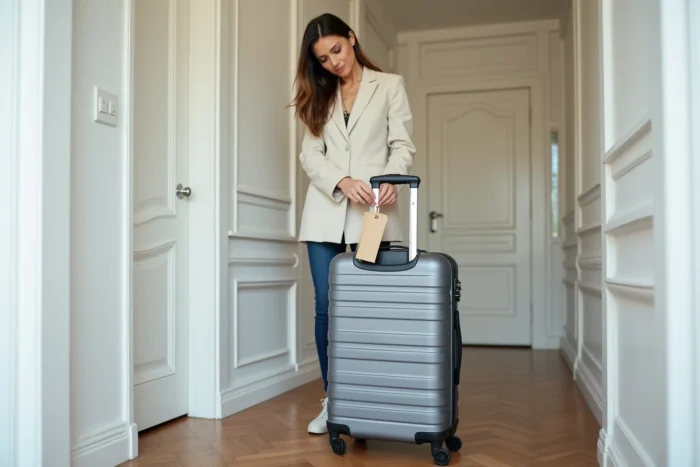
Minimalist Luggage Label: What Information to Keep, What to Remove
Have you ever noticed the amount of personal data displayed on some luggage tags? Full name, postal address, landline and mobile phone numbers, email address. These exposed details are enough to signal an empty home during your vacation.
A minimalist model retains only the essential information for an agent to locate the owner of the luggage:
- Last name and first name initial, in clearly legible capital letters (no fancy fonts, no italics)
- One mobile phone number, preferably with the international dialing code if you are traveling outside France
- A short email address, safer than a postal address as it does not reveal your place of residence
Remove the full postal address. A phone number and an email allow the airline or hotel to contact you without broadcasting your home address on an airport conveyor belt.
Readability from a Distance: Font Size and Contrast
A sorting agent sees hundreds of bags per hour. Your label must be readable from an arm’s length away, effortlessly. Aim for a sufficiently large font size (especially for the last name) and strong contrast: black text on a white or light-colored background.
Avoid dark colored backgrounds, decorative patterns, or handwritten fonts. The most effective design is also the simplest.
Free PDF vs Online Application: Which Tool to Choose for Printing
Two approaches coexist for creating a luggage label at home.
The first is the ready-to-cut PDF file. You download it, open it, and start printing. No account creation, no login required at the time of printing. It’s the fastest solution when you’re packing your bags the night before departure.
The second involves using an online generator (like Parchance.fr or Canva). These tools allow you to customize colors, add a theme, or modify the layout. The result can then be downloaded as an image or PDF.
Why prefer the minimalist PDF? Because it remains functional without internet access once saved on your computer or phone. A locally stored PDF file does not depend on any server. If a generator’s site is down at midnight, your label is already ready.
Bluetooth Trackers and QR Codes: Complementing the Paper Label Without Replacing It
In recent years, personal trackers like AirTag, Samsung SmartTag, or Tile have been increasingly slipped into the suitcases of travelers. These small devices locate lost luggage via Bluetooth and community network.
These devices work well as a complement to a physical label, but they do not replace it. An agent on the ground handling your suitcase has neither the time nor the equipment to scan a tracker. They read what is visible on the outside of the luggage.
QR Code on the Label: Useful or Superfluous?
Some PDF models include a QR code linking to a contact page. The idea is appealing, but the reality on the ground is more nuanced. A poorly printed or crumpled QR code becomes unreadable for a scanner. IATA resolution 753 has strengthened the digital tracking of luggage by the airlines themselves, but this traceability relies on the barcode attached at the check-in counter, not on your personal label.
If you insist on having a QR code, make sure it redirects to a simple page (name, phone, email) and that it is printed with maximum contrast. It remains a complement, not a replacement for text readable to the naked eye.
- Paper label: visually identifies the luggage for agents and other passengers
- Bluetooth tracker: locates the luggage remotely in case of loss or delay
- QR code: offers quick digital access to contact details, provided it is readable
The combination of all three offers the best coverage. The printed PDF label remains the foundation because it works without batteries, apps, or networks. A laminated rectangle of paper withstands more failures than an electronic gadget.