An outdoor layout that lasts over time relies on precise technical choices, not on an accumulation of plants and furniture. The substrate, the hydraulic management of the plot, the choice of plant layers, and the lighting condition the overall result. Here we address the structural points that most general public guides overlook.
Rainwater management on the plot: swales and rain gardens
Several revised PLUs since 2023 impose or recommend the infiltration of rainwater directly on the plot rather than its discharge into the collective network. The Climate and Resilience Law and its implementing decrees accelerate this trend. Ignoring this constraint risks a refusal of the development permit or costly compliance after the work.
The landscape swale (a planted basin in length, a few tens of centimeters deep) and the rain garden (a planted depression connected to a downspout) serve this function while creating a structuring visual element. We recommend positioning them in the natural low point of the terrain to avoid any unnecessary earthworks.
Plants suited to these areas alternate between temporary submersion and drought: marsh iris, sedge, purple loosestrife, common bulrush. Their deep rooting stabilizes the soil and filters particles. By combining these systems with permeable surfaces (stabilized gravel, cellular slabs), it is sometimes possible to completely forgo a collection pit.
Entrusting the design of these structures to a professional capable of cross-referencing soil reading, topography, and plant palette changes the quality of the result. Calling on landscaping with Le Jardin de Gaïa allows for the integration of this hydraulic dimension right from the master plan, before any earthworks.

Mineral materials in a natural garden: gravel, local stone, and permeable surfaces
The mineral is not the enemy of the natural. Gravels and local stones structure a sustainable and coherent garden as long as they are chosen according to the geological context of the site. A light limestone in a granite region produces an immediate artificial effect, regardless of the quality of the implementation.
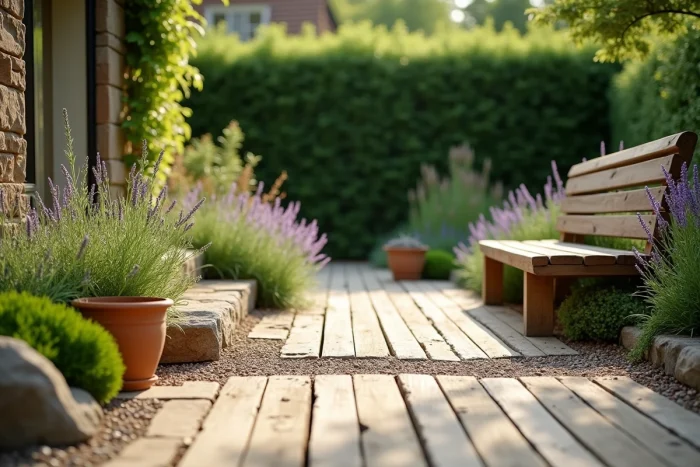
For paths and terraces, permeable coverings (compacted crushed gravel, grassed joint slabs, pavers laid on a sand bed) meet infiltration requirements while limiting weeding. The thickness of the bedding layer and the grain size of the crushed material determine stability over time.
- Local limestone in opus incertum for terraces: quick patina, good frost resistance if the stone is tested for frost, immediate visual integration with old buildings.
- River rolled gravel as mineral mulch on beds: natural drainage, elimination of chemical weeding, necessary replenishment only every few years.
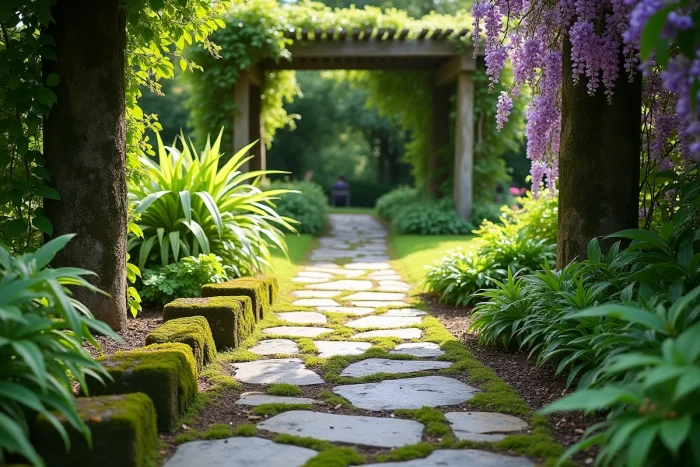
- Japanese stepping stones in raw natural stone for secondary pathways: reduced ground footprint, grass growth between slabs, no formwork.
A common mistake is to lay geotextile under the gravel of the beds. This felt eventually degrades, rises to the surface, and prevents the biological life of the soil. A thick organic mulch layer (wood chip) followed by a mineral layer on the surface yields better long-term results.
Plant layers and ground cover: structuring without excessive maintenance
A natural garden operates in overlapping layers, like a forest edge. High canopy (trees), intermediate layer (large shrubs), low layer (compact shrubs, grasses), and ground cover at soil level. Each layer fulfills a role: cast shade, windbreak, habitat for beneficial wildlife, suppression of weeds through dense coverage.
We observe that most so-called “natural” gardens fail due to a lack of ground cover. Without this last layer, the bare soil between plantings turns into a nursery for weeds and necessitates constant maintenance. Persistent ground covers (pachysandra, geranium macrorrhizum, vinca minor, epimedium) colonize the space in two to three seasons and require only annual pruning.
Combining perennials and grasses for a four-season display
Ornamental grasses (miscanthus, molinia, calamagrostis) bring movement, vertical texture, and winter interest when most perennials are dormant. Their pruning occurs at the end of winter, in a single intervention. When paired with perennials with staggered blooms (autumn asters, spring perennials, summer echinaceas), they ensure a structured bed from spring to the first frosts.
The ratio we recommend: about two-thirds of ground cover and grasses to one-third of prominently flowering perennials. This apparent imbalance produces a more coherent effect than a bed overloaded with seasonal flowers that leaves visible gaps out of season.
Outdoor lighting and nocturnal biodiversity: reconciling comfort and wildlife
The French Office for Biodiversity (OFB) and the National Museum of Natural History have been alerting since 2022 to the impact of garden lighting on nocturnal pollinating insects, bats, and birds. A garden designed as a coherent ecosystem cannot ignore this data.
The recommendations are precise:
- Warm color temperature (below 2700 K), which attracts significantly fewer insects than white or bluish light.
- Light flow directed towards the ground, never towards the sky or the beds. Recessed lights in steps or low bollards fulfill this role.
- Presence detectors in passage areas, programmed extinction in the middle of the night for ambient lighting.
- No permanent lighting in hedge or dense bed areas, which serve as refuge for nocturnal wildlife.
Well-designed lighting consumes less and protects beneficial wildlife that naturally regulates garden pests. Several community guides published between 2023 and 2024 incorporate these recommendations into their landscape specifications.
Nocturnal visual comfort relies more on the contrast between illuminated areas and dark areas than on raw luminous power. Three low light points, well positioned along a pathway, are enough to secure a medium-sized garden without turning the space into a parking lot.
Designing a natural and harmonious outdoor space involves treating soil, water, plants, and light as an interdependent system. Every technical decision made upstream reduces maintenance and strengthens the coherence of the garden over the long term. Decorative trends come and go, but the ecosystemic logic of a well-thought-out layout remains.