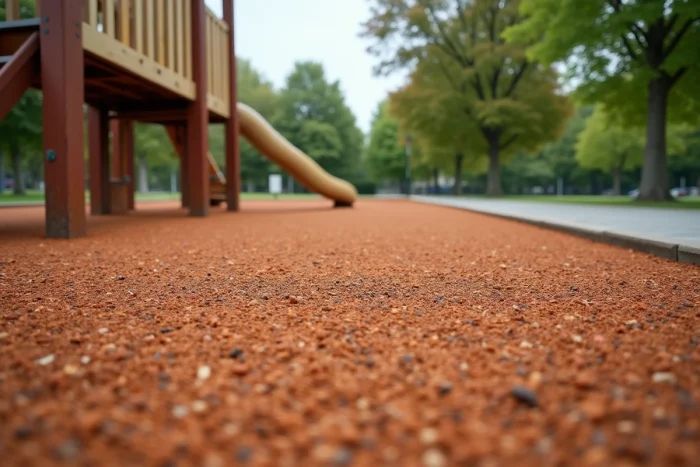
The NF EN 1177 standard remains the only reliable reference for validating a surface’s ability to absorb a critical impact. Since its amendment in 2025, it requires a minimum recyclability certification of 95% for EPDM surfaces, which reshuffles the cards among suppliers.
Choosing a safe flooring for an outdoor playground is not just about comparing materials: it is primarily a calculation of critical fall height (HIC) related to the thickness and density of the product.
Critical fall height and choice of flooring thickness
The determining parameter, before any aesthetic consideration, is the critical fall height (HIC). This value, measured according to NF EN 1177, defines the maximum height from which a child can fall without the risk of severe head trauma. Each surface has its own HIC that varies with its thickness.
We regularly observe sizing errors on installations where the thickness of the surface has been chosen arbitrarily. Equipment with the highest point reaching two meters requires a surface with an HIC exceeding this value, with a safety margin. An insufficiently thick poured EPDM surface does not provide more protection than raw concrete beyond its HIC.
To select a suitable Future Maman playground surface, it is essential to systematically cross-reference the product’s technical data sheet with the maximum height of each piece of equipment installed in the area. Recycled rubber tiles, poured EPDM surfaces, and wood chips do not achieve the same HIC at equal thickness.
- Standard rubber tiles generally cover low-height falls, suitable for structures less than one meter fifty.
- The poured EPDM surface allows for thickness adjustments to the nearest centimeter, providing finer coverage of HIC requirements for tall structures.
- Wood chips require a thick layer and a retention frame to maintain their shock-absorbing capacity over time.
Poured EPDM or rubber tiles: durability in real conditions
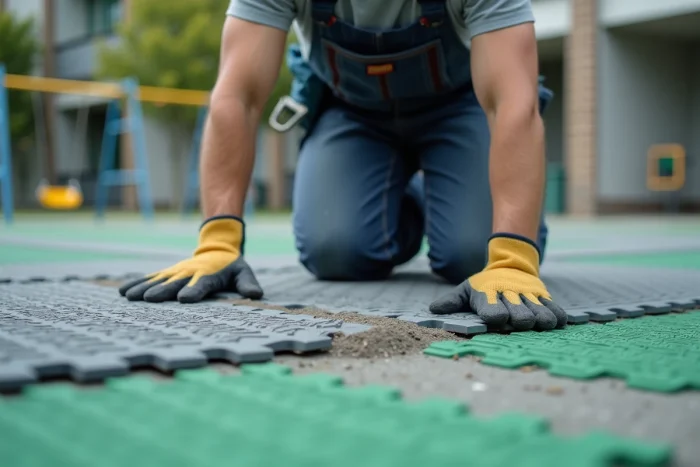
The choice between poured surfaces and prefabricated tiles is not a matter of taste. The SNNA study conducted in Occitanie in 2025 documented cracking of thermobonded EPDM tiles after 18 months under intensive UV exposure in the Mediterranean region. Poured surfaces, with their monolithic structure that has no joints, resist this degradation much better.
Tiles remain relevant in temperate climate areas or for temporary installations. Their main advantage: they can be replaced individually in case of localized damage, without needing to redo the entire surface. However, the joints between tiles accumulate debris and moisture, which accelerates peeling in humid conditions.
The poured EPDM surface requires a draining underlayer and a stable support (concrete, asphalt, or compacted gravel). Without this preparation, pockets of water form under the surface and cause peeling due to freeze-thaw cycles. The quality of the support conditions the longevity of the surface as much as the material itself.
Maintenance and aging of shock-absorbing surfaces
A well-laid poured surface retains its shock-absorbing properties for several years without heavy maintenance. An annual high-pressure cleaning is sufficient in most cases. Tiles require checking the joints and regular repositioning, especially after freezing periods.
Wood chips, on the other hand, compact and decompose. Their shock-absorbing capacity drops quickly if the volume is not replenished each season. This is a recurring cost often underestimated in municipal budgets.
Safety standards and recyclability requirements for playgrounds
The NF EN 1176 regulates the design of equipment, while NF EN 1177 governs the design of shock-absorbing surfaces. Since the 2025 amendment, NF EN 1177 includes a minimum recyclability requirement of 95% for EPDM aggregates, steering the market towards Cradle to Cradle certified suppliers.
This regulatory evolution has a direct impact on public tenders. Municipalities launching a playground project must now verify that the proposed surface meets this threshold, under penalty of non-compliance. Manufacturers lacking this certification are gradually being excluded from the markets.
Bio-based surfaces and plant-based binders
A fundamental trend, documented by ADEME in its March 2025 report on bio-based materials for public spaces, concerns shock-absorbing surfaces made from bio-based resin. These products replace petrochemical polyurethane binders with a plant-based binder, without altering the mechanical properties of the surface.
Adoption remains concentrated on European public projects with high environmental requirements. The additional cost compared to classic EPDM decreases as volumes increase, but we recommend verifying that the technical data sheet of the bio-based product has been tested according to NF EN 1177 in its 2025 version.
Accessibility for people with reduced mobility and non-slip surfaces for inclusive playgrounds
The American ASTM standards (F1292-25) have recently integrated specific requirements for accessibility for people with reduced mobility, with criteria for non-slip texture. France is beginning to draw inspiration from this to design inclusive playgrounds where a wheelchair can move without obstacles.
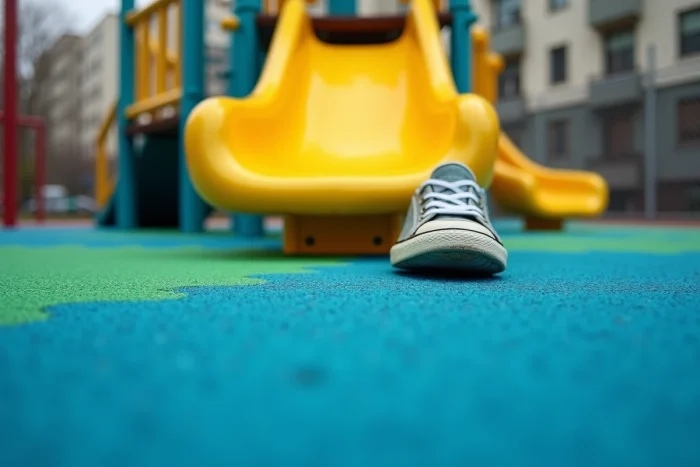
A light-colored poured EPDM surface with a textured finish meets this dual objective: compliant shock absorption and a walkable surface for wheels. In contrast, tiles with raised joints create bumps that block small wheels and walkers.
We recommend specifying in the specifications a maximum slope of 2% and an absence of bumps greater than 2 mm between tiles or between poured surfaces and edges. These details, rarely mentioned in standard quotes, make the difference between a truly accessible playground and one that claims inclusivity without practicing it.
The choice of flooring for a playground hinges on three technical parameters: the HIC related to the height of the equipment, the material’s resistance to local climatic conditions, and compliance with the 2025 regulatory requirements. Everything else, colors, patterns, shapes, comes only afterward.