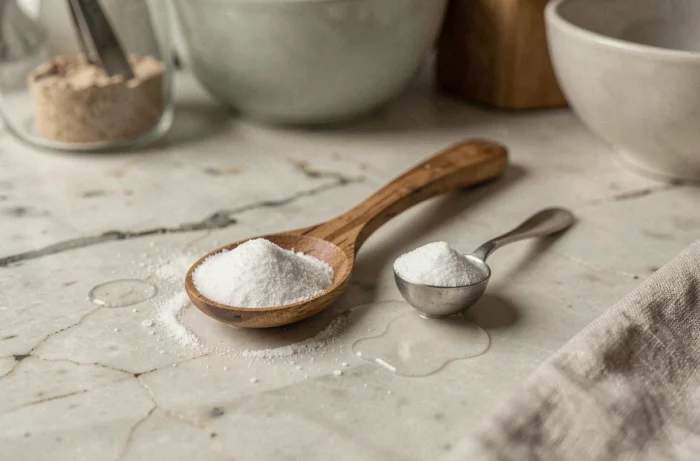
Pour pouring a tablespoon of olive oil or a teaspoon of salt into a mixture seems trivial. As long as the quantity remains approximate, the dish manages fine. But as soon as a baking recipe or a precise measurement comes into play, the actual capacity of these utensils changes everything about the final result.
Measuring spoon or table utensil: a confusion that skews recipes
Have you ever noticed that two tablespoons taken from different drawers don’t look the same? That’s normal. A table utensil is not a calibrated measuring instrument. Its shape, depth, and width vary from one manufacturer to another.
When a recipe states “a tablespoon,” it refers to a measuring spoon graduated in milliliters, not the utensil used to eat soup. The difference may seem subtle, but it can represent several milliliters of difference in a single measurement.
To understand the capacity of a tablespoon and a teaspoon, we need to start with the reference volumes used in the common metric system: 15 ml for a level tablespoon, 5 ml for a level teaspoon. These values serve as standards in most French-language cookbooks.
The dessert spoon, less known, falls between the two with about 10 ml. Keeping these three benchmarks in mind is enough to navigate most recipes without a scale.

Milliliters and grams: why conversion depends on each ingredient
A level teaspoon always contains 5 ml of volume. However, the weight in grams changes according to the density of the ingredient. This is the point that often trips people up in the kitchen.
Take water as an example: 5 ml corresponds to 5 g. Logical, since its density is 1. Granulated sugar follows a similar logic. But flour, being lighter and airier, weighs less for the same volume. Conversely, fine salt, being denser, weighs more.
Weight benchmarks for a level teaspoon
- Water, fine salt, granulated sugar, melted butter: about 5 g per teaspoon
- Flour, oil, semolina: about 4 g per teaspoon
- Starch, powdered sugar, cocoa powder: about 3 g per teaspoon
- Instant coffee: about 3 g per teaspoon
Weight benchmarks for a level tablespoon
- Fine salt, granulated sugar, butter, fresh cream, oil: about 15 g
- Flour, starch, raw rice, semolina: about 10 g
- Cocoa, ground coffee, breadcrumbs: about 8 g
- Grated cheese: about 5 g
Granulometry also plays a role. Granulated sugar does not pack the same way as powdered sugar in the hollow of a spoon. The finer an ingredient, the more it compacts, and the more its weight per spoon increases.
Level or heaped spoon: the real difference in measurement
The mention of “level” or “heaped” in a recipe is not decorative. A heaped tablespoon can contain double the volume of a level spoon, nearly 30 ml instead of 15 ml.
A heaped spoonful of salt can therefore double the amount of sodium in a dish. For salt or strong spices, this difference is immediately noticeable in taste. For flour in a cake, it alters the texture of the batter.
The most reliable technique is to fill the spoon and then run the back of a knife across the edge to level it off. This gesture takes two seconds and ensures a reproducible measurement from one time to the next.
Foreign recipes and tablespoons: the trap of Australian 20 ml
Are you following a recipe found on an Australian blog and applying the usual conversion of 15 ml per tablespoon? The measurement will be incorrect. In Australia, the standard tablespoon corresponds to 20 ml, which is one-third more than the current metric reference.
This discrepancy goes unnoticed with a less sensitive ingredient like flour. With salt, baking soda, or a concentrated spice, it’s enough to throw an entire dish off balance. American recipes use the “tablespoon” of 15 ml, identical to the French standard, but older British recipes may also present discrepancies.
How to check the correct volume
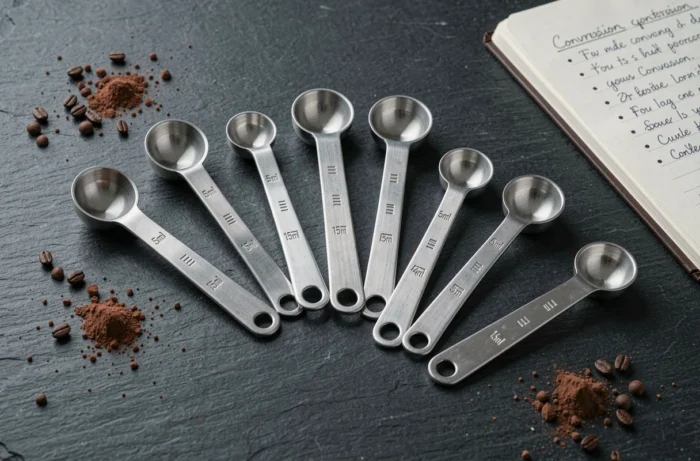
The safest reflex is to look for the mention “ml” or “tsp/tbsp” in the original recipe. If the recipe only states “1 tablespoon” without specifying milliliters, checking the country of origin allows for adjustment. A set of measuring spoons graduated in milliliters solves the problem, regardless of the country of the recipe.
Medication dosing: kitchen spoons are not medical devices
One last point often overlooked concerns liquid medications. Using a table spoon to measure syrup or a drinkable solution is not recommended. The variability between utensils makes dosing too imprecise for medical use.
The devices provided with the medication (oral syringe, graduated cup, medical measuring spoon) are calibrated for the prescribed dosage. Even if a teaspoon “holds 5 ml,” the utensil from the drawer may hold 3 or 7 depending on its shape.
In cooking, a 2 ml difference in sugar doesn’t ruin anything. For a medication, that same difference can alter efficacy or cause an overdose, especially in a child. Reserving kitchen spoons for cooking, and medical devices for treatments remains the simplest rule to remember.