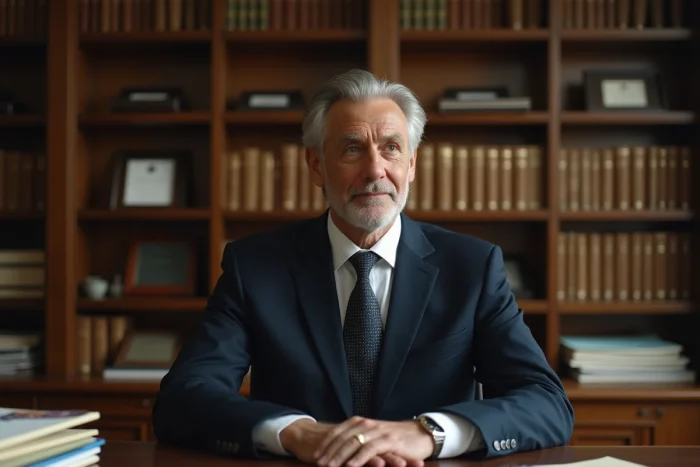
Alain Bauer is one of the most publicized criminologists in France. His interventions on security, police, or terrorism regularly occupy television space and press columns.
On one specific point, the silence is total: his married life. No couple photos, no wife’s name in interviews, no family confidences. This discretion of Alain Bauer regarding his private life is not an oversight. It is a constructed strategy that produces concrete effects on the perception of his work.
Alain Bauer’s Discretion: When the Absence of Personal Information Affects Credibility
When an expert comments on crime on television, the public evaluates two things in parallel: what he says, and who he is. The total absence of personal information about Alain Bauer creates a void that everyone fills in their own way.
For his supporters, this reserve reinforces the image of an analyst focused on the facts. For his detractors, the silence about his private life fuels suspicion. Some skeptics interpret this opacity as a sign of hidden connections, undisclosed interests, or a desire to control his public image.
This mechanism has a name in social psychology: the credibility bias. The less information one has to “place” a person (family, lifestyle, geographical anchoring), the more one tends to project their own suspicions onto them. In the case of a criminologist advising public authorities on security, this bias takes on a particular dimension.
A detailed article explores Alain Bauer’s private life and his wife from the perspective of this voluntary protection. The question deserves to be asked: does this discretion serve or hinder the reception of his analyses?
Family Protection and Security: A Real Professional Constraint
Alain Bauer does not work in an innocuous field. His professional background has placed him at the crossroads of public security, intelligence, and applied criminology. Individuals who regularly intervene on these topics are exposed to specific pressures.
Protecting his family circle is a concrete precaution, not a media whim. In the field of security and policing, making the names and faces of loved ones public puts them at risk, which most experts in this field seek to avoid.
This logic is found among other public figures in comparable sectors. Journalist Malcolm Gladwell, for example, has adopted a similar discretion in recent years in the face of growing media polarization, according to an analysis published in The New Yorker in November 2025. The cultural difference is notable: the European tradition grants more legitimacy to the separation of public and private life than the American model, where personal transparency is often expected.
What the European Data Protection Framework Changes for Public Figures
The European legal framework has evolved in recent years. Recent texts strengthen the sanctions applicable to media that speculate on private life without explicit consent. The CNIL recently issued a decision applying these provisions to a profile comparable to that of Alain Bauer in the context of a defamation case.
This regulatory strengthening provides legal support for the strategy of discretion. Publishing unverified information about the couple or family of a public figure now exposes one to concrete sanctions. The legal context has thus caught up with a practice that Alain Bauer applied long before these developments.
Rumors and Speculations About Alain Bauer’s Wife: How the Information Void is Filled
The absence of verifiable information about Alain Bauer’s married life does not prevent searches. Queries like “Alain Bauer wife marriage” are among the most frequent suggestions associated with his name. This phenomenon illustrates a paradox: the more a public figure protects their private life, the more curiosity intensifies.
The available public sources do not allow for confirmation of his wife’s name or the details of their marital situation. This observation is shared by almost all articles dedicated to the subject. Alain Bauer’s official biographies mention his professional background, his roles with security services, and his publications, without ever addressing the family sphere.
Why does this silence generate so many searches? Three factors combine:
- The reversed Streisand effect: by never responding to questions about his family, Alain Bauer keeps the subject in a state of perpetual curiosity. Each non-response reignites interest.
- The contrast between media omnipresence and the absence of visible personal life creates cognitive dissonance in the public, accustomed to television figures sharing a minimum of their daily lives.
- Regular controversies surrounding his background (accusations of favoritism, links to Freemasonry) nourish a fertile ground for speculations that spill over into the intimate sphere.
Alain Bauer and the Control of Public Image: A Consistent Method
Alain Bauer’s discretion is not limited to his married life. It is part of a comprehensive management of his image. His interventions are calibrated: he talks about security, criminology, and policing, rarely about himself. This compartmentalization is methodical.
In a media landscape where experts oscillate between popularization and personalization, Bauer chooses never to mix the registers. His authority rests on the strict separation between the analyst and the individual. This approach has a cost: it deprives his audience of human identification elements that, in other commentators, create proximity and trust.
The result is heightened polarization. Those who agree with his analyses see it as a mark of a rigorous professional. Those who contest them have an additional argument: if this man hides his private life, what else is he hiding?
The Paradox of Selective Transparency
Alain Bauer is willing to respond about his professional background, his ties to institutions, and his positions on public security. This partial transparency makes the silence about his family all the more visible. The boundary he draws is clear: public career, invisible couple.
This choice produces a documented effect in the reception of media personalities: the asymmetry of information leads observers to overestimate the importance of what is missing. Alain Bauer’s wife becomes a topic precisely because he does not talk about her.
Alain Bauer’s discretion regarding his private life is not accidental. It reflects a security constraint related to his area of expertise, a personal choice consistent with his communication method, and now a European legal framework that protects it. The persistent silence about his married life continues to generate searches, and the absence of response leaves the field open to the most varied interpretations.