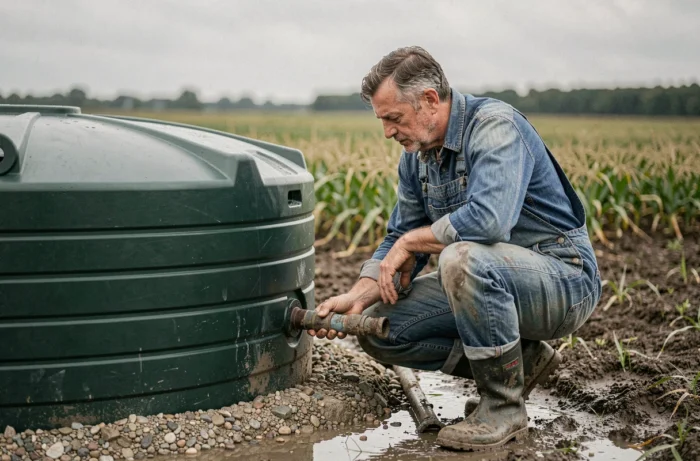
Storing rainwater on a farm helps reduce dependence on withdrawals from aquifers or waterways. Installing a rainwater harvesting tank represents a significant investment, and the financial aid available for this type of project does not operate as a national one-stop shop.
They vary according to the hydrographic basin, the department, and sometimes the municipality. Understanding where to look and under what conditions these grants are awarded helps avoid missing out on real funding.
Rainwater Harvesting in Agriculture: A Project That Doesn’t Get Funded Like for Individuals
For individuals, rainwater harvesting typically involves a collector connected to a gutter. In agriculture, the volumes and uses change the situation. A tank intended for watering livestock or cleaning buildings does not fall under the same framework as a structure designed to secure irrigation over several hectares.
This distinction has direct consequences on the aid. Public funders classify the project according to its use, not according to the equipment. A collector fed by roofs can fall under a rainwater management system. Storage intended for irrigation may be subject to stricter conditions: compatibility with drought restrictions, prior declaration or authorization, and sometimes justification for a reduction in withdrawals from the natural environment.
To identify the right systems, one must therefore look beyond the term “rainwater collector.” The keywords that open doors are quantitative water management, water savings, and adaptation to climate change. These are the entries that water agencies and Regions use in their calls for projects. You will find details of the available systems by territory in the dedicated article on Finance Factory, which lists the main funding avenues.
Water Agencies and Agricultural Grants: The Role of the Hydrographic Basin
Water agencies are the primary contacts for a water storage project on a farm. France has six, each covering a large hydrographic basin. Each agency sets its own priorities and aid rates.
Why this basin approach rather than a uniform national system? Because the pressure on water resources is not the same in Loire-Brittany and Rhône-Mediterranean-Corsica. Water agencies prioritize projects that are part of a collective strategy to reduce withdrawals, rather than the isolated funding of an individual tank.
In practical terms, this means that a grant application will be better received if it is part of a territorial project (a climate change adaptation territorial project, for example) or if it is supported by a group of farmers engaged in a common approach. The amount of aid and the coverage rate depend on the intervention program of the concerned agency, which evolves over multi-year cycles.
What Agencies Expect in a File
- A precise description of the use of the recovered water (watering, washing, supplementary irrigation) and the targeted volume
- Proof that the project contributes to reducing withdrawals from the natural environment, not just adding additional storage capacity
- A prior diagnosis of the farm, often carried out with the support of the Chamber of Agriculture, which assesses water needs and savings margins
- Compatibility with any existing usage restrictions in the basin (drought orders, water distribution zones)
Without this overall diagnosis, the file is often dismissed. Water agencies no longer fund a standalone technical installation: they fund an adaptation approach.
Regional and Departmental Aid for the Installation of an Agricultural Tank
Beyond water agencies, Regions and some departments offer their own grant lines. These aids are sometimes integrated into rural development programs co-financed by the European Union, sometimes from their own regional budgets.
The operation varies greatly from one territory to another. Some Regions specifically target investments related to the climate adaptation of farms. Others include rainwater harvesting in broader envelopes dedicated to the modernization of livestock buildings or greenhouses.
The accumulation of several aids is generally possible, but capped. A grant from the water agency can be combined with regional aid, provided that the total does not exceed a certain percentage of the project cost. This accumulation cap is specified in each intervention regulation.
Agro-environmental Measures and Payments for Environmental Services
Some operators may also benefit from agro-environmental and climate measures (MAEC) or payments for environmental services (PSE). These systems do not directly fund the purchase of a tank, but they reward practices that reduce pressure on water resources. A rainwater harvesting project can be integrated into a broader MAEC commitment, which strengthens the coherence of the file with respect to funders.
Preparing a Grant Application for a Rainwater Harvesting Tank
The concrete starting point is the Chamber of Agriculture in your department. They know the systems open in your basin, the deadlines for submitting files, and the local eligibility criteria. Some Chambers offer specific support to carry out the water diagnosis of the farm, which is often a mandatory prerequisite.
- Contact the Chamber of Agriculture to identify the aids available in your territory
- Conduct a water diagnosis of the farm before submitting an application
- Check with the water agency of the basin if a call for projects is ongoing or scheduled
- Consult the Region’s website to find the open budget lines (climate adaptation, agricultural modernization)
- Do not start work before receiving the funding agreement, as expenses incurred prior to the notification of aid are rarely eligible
The time between submitting the file and the disbursement of the grant can be long. Planning this timing in the financing plan avoids unpleasant cash flow surprises.
Farmers who associate their tank project with a broader reflection on water management (reducing leaks, choosing less water-consuming crops, reusing wash water) obtain better-rated files. Funders are looking for adaptation projects, not just equipment purchases.